Showing posts with label Changing Spaces. Show all posts

Thursday, 28 June 2012

Changing Spaces - A Review


Changing Spaces - A Review
by Valerie Grove 


Although I was closely involved in this project, my role in monitoring and documenting both the process and progress of Changing Spaces was defined by my collaboration with the artist, Jonathan O’Dea, and by my focus on editorial clarity in relation to the project’s online presence. As a consequence, I didn’t actually form an opinion of the work. However, now that the project brief has been fulfilled I can actually take a step back and approach the work, and the exhibition as a whole, from an analytical perspective rather than one of practicality.

This transition has been easier than anticipated for several reasons. Firstly, out of a total of 12 works I had only seen 3 in their finished state. The others I saw only in stages, either in the studio, or on-site in the case of the sculpture. It was only on completion of the hanging that I was able to see the totality of the project. So despite my familiarity with the sometimes literal nuts and bolts of the work and their contextual background, the exhibition itself was an unexpectedly original experience. The same applied to the sculpture. After documenting the early stages and the positioning of the piece, I had purposely avoided seeing it in its final state so this was also like seeing something fresh.

An understanding of the component parts of something does not necessarily entail an accurate perception of the complete and functioning whole. This applies particularly to the fact that the 11 wall-mounted works were united from the outset within a conceptual framework and therefore needed to cohere as a single visual entity, as well as stand as individual works in their own right.


In terms of individuality each piece largely succeeded. Grouped according to size and united in monochromatic and sometimes textural, material or structural motifs, the works were not only visually striking but created atmospheres that were not always comfortable. In the case of Modification, for example, an electric grinder with jagged holes gouged deeply into the handle had a rather disturbing undercurrent of violence not completely offset by the control imposed through its pristine, if texturally erratic, white surround.

This was also the case with the sharp wooden symmetry of angles exploding menacingly from the centre of Transmutation 1. However, the tension inherent in this work was balanced beautifully by its companion piece Transmutation 2, in which an ‘implosion’ created both a sublime visual spectacle and a range of imaginative possibilities.

This balance is evident throughout the show. Each work seems to be displayed with a particular companion. Transfiguration and Industrial Landscape 1, for example, contain familiar objects like breeze blocks, air vents and radiator parts, but where one suggests imprisonment, or an entrance into somewhere you probably don’t want to go, the quiet beauty of the other relieves and reassures.


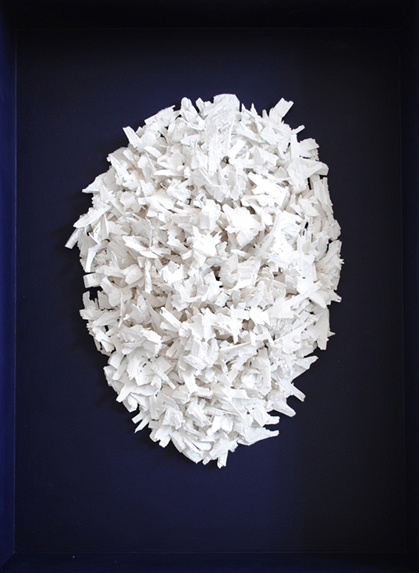
The three works that use the larger objects found in the Olympic and Lee Valley Parks are grouped together in a way that highlights both their industrial sensibility and their complete transformation. Industrial Landscape 2 memorialises a solid iron pipe which was once part of a Victorian heating valve. Changing Spaces 2 contains a perfectly straight line of London bricks split down the middle with an inlay of wood so polished it looks like metal. In Changing Spaces 1, however, a black pallet is convexly inlaid with a gravity defying circle of sharp, white wood chips. These seem incongruous as part of the piece itself but they constitute a motif that connects to the two other pieces in the show, Deconstructed Landscape 1 and 2.


The fragility and delicacy of these tiny splintered objects and their complex arrangements seem to be a huge material and compositional contrast to the solidity and weight of other works, but conceptually they are in tune. They are both shattered and composed simultaneously, which informs the sense of post-industrial dystopia that pervades this show. There is a constant negotiation between violence and control with the objects themselves looking like the remnants of a lost civilization that now command an awkward combination of nostalgia, reverence and fear.

The show definitely makes the best of the space at the Waterworks. There is a degree of material compatibility in the grey metal grids and wooden wall frames which are effective as backgrounds to each group of works. However, it was frustrating that the impact of the collected works as one conceptual installation piece was completely disrupted. This is not a gallery but an educational area of a nature reserve, so it was inevitable that the existing contents of the space would be battling for domination. It was possible to catch glimpses of how the works in Changing Spaces interlaced and created their own environment, but these glimpses just added to the frustration. I have seen several exhibitions at the Waterworks space and it is ideal for group shows containing a diverse and colourful mix of works that stand alone and do not require visual cohesion. Inherent in Changing Spaces, however, is the kind of conceptual visualisation that actually requires a traditional white cube space to be fully realised.


The sculpture on the other hand is in the perfect location. Created from a whole tree trunk, Intervention stands outside in leafy surroundings a short walk from the main building. Although connections to the exhibition inside are evident in the materials and in the aesthetics of preservation and even fossilisation, there is a sense of this being a separate project. That said, the sculpture does have a similar post-apocalyptic feel but it seems more a triumphant survivor than a cadaverous artefact of loss.

Location and the use of wire mesh and steel straps, means that it changes constantly according to the elements consolidating its vibrancy. In the sunlight it glints and glitters and the rain brings streaks of rust from the nails hammered like ceremonial armour into the top of the trunk. The inevitability of change clearly written into this work is also a celebration of natural cycles and renewal and is both positive and forward looking. Much of the work inside does not allow the viewer that luxury. It is perhaps within this tension that the project is complete.


Originally published on Nature Strikes Back, June 22nd 2012.

Friday, 22 June 2012

Review by Thomas Hardy

Walthamstow based artist Jonathan O’Dea opened his new exhibition this weekend at the Waterworks in the Lee Valley Park. I’ve known Jonathan for a few years now and we’ve spent the odd evening in the Rose and Crown talking, I am sure very wisely, about art and music, amongst other things. One subject we both keep returning to is Waltham Forest’s position on the edge of the city – and the way that this perhaps denies this part of London the identity and attitude of its East London neighbours, or the home counties security of adjoining Essex.

The first exhibition I saw of Jonathan’s work seemed to me to directly reflect these themes – a series of abstract landscapes on whose horizons shimmered objects which may have been trees, or could have been industrial buildings. Perhaps these were echoes of this part of the East End’s memories – of the factories and warehouses which were cleared from the Lee Valley when work began on the Olympic Park, or maybe they were natural features which have been covered up by the urban sprawl – future echoes from the utopian world of William Morris’s News from Nowhere.

Title: London is London, England is England

When I visited Jonathan in his studio a few weeks ago those landscape canvasses were stacked in racks in the corner – and he has clearly compartmentalised that work mentally as well as physically. The pieces he was working on for this exhibition are strikingly different. Jonathan has had free reign to remove junk and waste from the Lee Valley park and has produced a series of pieces using materials he has found there, or reclaimed from disused rooms in warehouses. Wooden pallets have been transformed into organic looking structures, bricks neatly mounted, painted, and then partially annihilated. Wooden materials are made to look metallic and old disused pipe work is newly painted.


The most ambitious piece in the show will be a large site specific sculpture in which a slowly decaying tree is encased in a wire mesh.


As this piece rises at the edge of the glistening Olympic park and those transformed pieces of rubbish are mounted as artworks near to where they were once abandoned, this show promises to encourage viewers to reflect on the way we change and transform the landscapes around us, to imagine how the ground beneath our feet was once different, and wonder how future generations will transform the places we know so well.

See Thomas Hardy's blog: From the Edge

Monday, 18 June 2012

Opening Day

Thanks to everyone who came to the opening. It was great to see so many people there. If you have any  photos or comments please send to me and I'll post them up on the blog.  See link below for local press coverage: New Sculptures unveiled at Nature Reserve

Mayor of Waltham Forest, Richard Sweden opening the exhibition

Jonathan O'Dea and the Mayor of Waltham Forest Richard Sweden unveiling the site specific sculpture: Intervention


Visitors making their way down to the sculpture site


Friday, 15 June 2012

Notes from a a hanging

Q) Congratulations. It's all hung and ready to go. Apart from the sculpture how many works did you end up producing and are you happy with the way things look?


Thanks. I ended up with a total of eleven wall mounted works now hanging neatly in the Waterworks! Given the size constraints of my studio, it wasn't until the day of the hanging that I could actually see the eleven works together in a large enough space for them all to be visible. So I was really quite nervous about how things would work out and whether the individual pieces would cohere as a single conceptual show within the space.


So I am very happy and relieved at how smoothly the hanging went and how the show looks. It is great to finally be able to see it all together but I have to say a huge thanks to Neil Irons who helped me to hang the show.

There are a whole list of people I would like to thank actually so here goes.... 
  • Arts Council England for funding the project 
  • All the team from the Waterworks Nature Reserve and Lee Valley Park Authority especially Angela Oliva, Manager at the Waterworks and Dave Farthing, Waterworks Park Ranger (who is now an expert in conceptual art!) 
  • The ODA who gave me access to the Olympic Park which helped inform the development of the  project 
  • Neil Irons who continues to be a positive critic of my work and ensures I don't mess it up totally! 
  • Valerie Grove who has done a brilliant job in conveying the project and the artwork through this blog 
  • Tim Bennett Goodman who has always been a very good friend and support to me, and the wider cultural community of Waltham Forest 
  • Thomas Hardy for his support and advice and for being a big fan of my work. 
  • Andy Rogers, the Irish Embassy in Britain and also the Irish World Newspaper for support and encouragement
  • Fiona Audley and Malcolm McNally from the Irish Post Newspaper 
  • George Nott from the Waltham Forest Guardian 
  • And finally .....  Sarah Morgan, who has constantly been there for me. 
Thank you all very much and see you tomorrow!  


Thursday, 14 June 2012

Turning on the Waterworks


The exhibition opens on Saturday and I was helping out with the hanging today so thought I would just give a quick profile of the Waterworks Nature Reserve especially in relation to art, artists and this exhibition in particular.

The Waterworks Nature Reserve opened ten years ago. Part of the huge Lee Valley National Park, the Waterworks has a team around it consisting of conservationists and experts in wildlife habitats,  woodlands and local history which includes the fascinating Middlesex Filter Beds. It also has a small but perfectly formed golf course and a lovely, quiet and comfy cafe!


Since 2010 the educational area of the centre has been opened up for artists providing a unique, local exhibition space in an area which has an almost complete lack of them. The person to thank for this is Angie Oliva who is manager at the Waterworks. I asked her about art, the Waterworks and Changing Spaces and this is what she said:
I thought we had a really nice building and that we could definitely use it much more for the local community as well as help to introduce a new audience to the Lee Valley Park. For me it's all about nature, the environment and expressing yourself ...... and I really like art! 
We are all delighted to be hosting Changing Spaces. Jonathan's work is very beautiful and I love the sculpture! I love that it's natural - that it's a whole tree - but I also love the fact that it's actually free. It's not entangled in anything and there's nothing else to distract you from it. You can just see it exactly for what is.


Valerie Grove

Friday, 18 May 2012

Up close and textural

Here are a few images showing some of the textural detail in the materials. Some are from finished works and others were taken when the work was in progress.


Wednesday, 18 April 2012

Video tour of the Studio

Here is a short tour of my studio which gives a general idea of the work I have produced for this project so far. Not all of the pieces are finished but they are all well on the way leaving me free to focus on the on the sculptural piece I will be doing on-site in the Lee Valley Park. 

This video also shows just how much it is actually possible to do and to fit in a very small space! 


Monday, 5 March 2012

Art in progress 1


Q) What are you working on at the moment? 

Stage 1

I'm at the studio a lot at the moment working on the new pieces for Changing Spaces. The studio is really full of stuff that I have been collecting over a long period for this project so I am having to work around it where I can  and take it outside when I can't!.

These pictures have been taken over the last 3 weeks and give a sense of how the objects progress from their original state and how the work comes together. The centre piece of this particular work is an old valve pipe from an industrial heating system. The valve pipe was found discarded in an abandoned warehouse building near the Lee Valley Park.

Stage 2


The pipe is probably between 40 and 50 years old. I have kept it intact so it is more or less in the shape that I found it although it is of course repainted. The base that provides the support and frame for the transformed valve is constructed from corrugated board and plywood.

This piece of art in particular reflects very directly the industrial landscape which dominates this area. It also plays around with the idea of regeneration - of turning something old into some new.


Stage 3

Saturday, 11 February 2012

Interview (2)

Q) It seems that 3D has emerged organically from your painting but did you have any interest in sculpture before conceiving of Changing Spaces or is this a completely new  thing for you? 

Part of my interest in sculpture and 3D artwork does go back a long way to GCSEs at Chiswick Community School in West London in the early 1990s. We had visiting teacher who introduced me to the media of assemblage. Although this was a short-lived introduction it left a strong impression on me although, at that time, the process of creating  the assemblage was often much more appealing that the outcome!

Assemblage was about using found objects and presenting them in their raw state, so when I produced my first 3D artwork in 2010 I used the general ideas of assemblage and added my own style and approach. My aim was to try and strike a balance between the conceptual and the aesthetic. The results off the first group of sculptural  works led me to explore other possibilities. Ironically I found myself going back to some basic creative principles I had as a teenager and the freedom to experiment in order to develop ideas. Nearly all my ideas for each sculpture are inspired by the physical process of creating the work. I find it nearly impossible and actually quite restricting to actually plan each piece in terms of preparatory sketches or set processes.

The first 3D work I produced was called Leaded Tree. I had  found a piece of tree branch on an industrial estate in the Lee Valley Park and I took it back to the studio intending to carve it in some way. First I found that the tools I was using had a huge impact on the nature of the carving. In fact, it was the chisels themselves which began to dictate the work rather than any ideas I had for it. At that time my studio building was being renovated and I had picked up several scraps of lead which were just sitting in my studio as I was working on the wood. I had often worked with lead doing building work so I knew how supple it was and how easy to shape. The two materials are similar in the sense that both lead and wood are created by nature but each is also very much perceived, and used, as an industrial staple. So these two things just merged to form my first sculptural piece in 2010.

Saturday, 4 February 2012

Interview - Part One

As one of the collaborative aspects of Changing Spaces,. artist and writer, Valerie Grove will be conducting an ongoing interview as the project unfolds. Her first question is addressed in this post.

1. Up until this point all of your work has been 2D and all has been painting. Although there have been changes in your painting style over the years this project seems to mark a major shift in your artistic development. How did this move to 3D emerge? 

In 2009 I produced several paintings in which the surfaces were very thickly layered  and the paint was actually applied over other materials such as corrugated card inlaid into MDF. I left parts of the underlying materials exposed which revealed the depth of the layers and actually gave the appearance of 3D sections within the flat surface of the whole work. This was important because it was transitional work which really brought my interest in 3D into focus.


I took this much further in 2010 with four experimental pieces of art  in which I used found objects to produce three-dimensional wall mounted works. These were included in a solo exhibition exploring the physical relationship between London and England shown at Vestry House Museum, London E17. There was a lot of  interest in the approach I took in producing these works which encouraged me to investigate other ways of working within a 3D aesthetic using found objects. 


I was fascinated by the physical scale of the development of the Olympic Park and its structural complexities and was lucky to be given an opportunity to visit the Park in its development stages. The ODA and the Lee Valley Park subsequently provided me with materials to produce a more ambitious body of work and the Lee Valley Park then offered me an exhibition as part of their 2012 programme. So this is my first real opportunity to just focus on producing 3D artwork and is how Changing Spaces has emerged. 

Monday, 23 January 2012

Welcome to Changing Spaces

Raw materials
Over the next few months I will be developing new visual art for the Cultural Olympiad 2012. This project is supported by Arts Council England and the Lee Valley Park Authority. This blog is an opportunity for people to engage in the creation of the project and to post comment and opinion. The series of completed works will go on display in June 2012 at the Waterworks Nature Reserve in Waltham Forest.

My aim is to produce art that is abstract and which makes people curious about the materials and how the work is constructed. I want to link this curiosity with the physical techniques and methods used in the regeneration of brownfield sites (the Olympic Park) and the revitalising of the Lee Valley Park. My interest in these practical, creative processes is partly a result of working on construction sites over many years. This experience informed my own interest in regeneration and all the things that go unseen by the public when regeneration projects are undertaken as well as their huge impact on our visual and cultural environment. 

Transformed
 
The Olympic Delivery Authority has provided me with access to the Olympic Park to inform the development of Changing Spaces. Additionally, the ODA and the Lee Valley Park Authority have provided me with recycled building materials and found objects for inclusion in the final artworks. This access will not only make this project feasible, but it will enable me to capture some of the more abstract yet intrinsic physical changes like those created by construction workers, park visitors and natural phenomena - the kind of minutiae that people walk by every day but never really notice.

A New Narrative: Deconstructed

Over the last 15 years I developing the concept of deconstructed art, collecting objects, breaking them down and turning them into sculpture...